Skip to content


Master Contract Terms: Your Legal Document Guide Unveiled
How to Read Legal Documents: Simplify Contracts, Wills & More
Legal documents are written instruments that create, record, or transfer rights and obligations and understanding them reduces legal and financial risk while protecting your interests. This guide teaches you how to identify core components, decode legal jargon, and evaluate enforceability so you can read contracts, wills, deeds, leases, and court paperwork with confidence. Many people struggle because legal language bundles precise obligations, technical definitions, and formal clauses into dense text; this article decodes that structure and offers practical workflows you can use immediately. You will learn what makes a document legally effective, which common document types to prioritize, the key components and clauses to inspect, techniques to simplify legalese, and a step-by-step review checklist for spotting material facts. Throughout, the guide uses plain-English explanations, comparison tables, and actionable lists to help you move from confusion to clarity when reading legal documents and legal agreement components.
What Are Legal Documents and Why Is Understanding Them Important?
A legal document is a formal written record—such as a contract, will, deed, lease, or judicial opinion—that establishes rights, duties, or legal status and is designed to be enforceable by law. These documents work by identifying parties, stating terms, and using signatures or formalities that signal mutual assent and legal capacity; the mechanism of enforceability typically involves offer, acceptance, consideration, and a governing law clause that defines remedies. Understanding legal documents is important because misreading obligations or overlooking critical clauses can cause financial loss, loss of rights, or unintended long-term commitments. Below is a brief list summarizing the primary points of importance and the direct benefits of comprehension.
- Protects rights by clarifying who gains which benefits and who holds responsibilities.
- Reduces liability by identifying indemnities, limitation-of-liability clauses, and financial exposure.
- Enables negotiation by revealing ambiguous or one-sided terms that can be revised.
- Preserves evidence by ensuring signatures, effective dates, and formalities are recorded correctly.
Grasping why legal documents matter helps you focus on what to check first; the next subsections define legal documents and explain how they create enforceable obligations.
What Defines a Legal Document and Its Key Characteristics?
A legal document is defined by its purpose, formal structure, and intent to create legal relations, often evidenced by signatures, witness requirements, or statutory formality. Key characteristics include explicit identification of parties, a definitions or recitals section that frames meaning, operative clauses that allocate rights and duties, and execution blocks showing signatures and effective dates that trigger obligations. Capacity and mutual assent are essential: parties must have the legal ability to enter agreements and manifest agreement through offer and acceptance, which together support enforceability. For practical reading, scan for these markers—names, dates, signature lines, and the definitions section—because they determine how the rest of the document should be interpreted and applied.
These structural markers naturally lead to an examination of how documents translate into rights and obligations, which is the focus of the next subsection.
How Do Legal Documents Establish Rights, Obligations, and Enforceability?
Legal documents establish enforceable rights and obligations through identifiable formation steps: an offer (a proposal), acceptance (agreement to the proposal), consideration (an exchange of value), and clear terms that outline remedies and jurisdiction. Governing law and jurisdiction clauses determine which courts or legal rules apply if enforcement becomes necessary, and clauses like severability or integration can affect how ambiguous terms are treated. For example, a sales contract becomes enforceable when the seller offers goods, the buyer accepts, and payment or other consideration is exchanged; a conflicting or missing element may void enforceability or invite interpretation by a court. Understanding these mechanisms helps you spot fatal defects versus negotiable issues when reviewing any legal instrument.
Understanding enforceability leads naturally into recognizing the common document types you are likely to encounter and how they differ in purpose and structure.
Which Common Types of Legal Documents Should You Know?
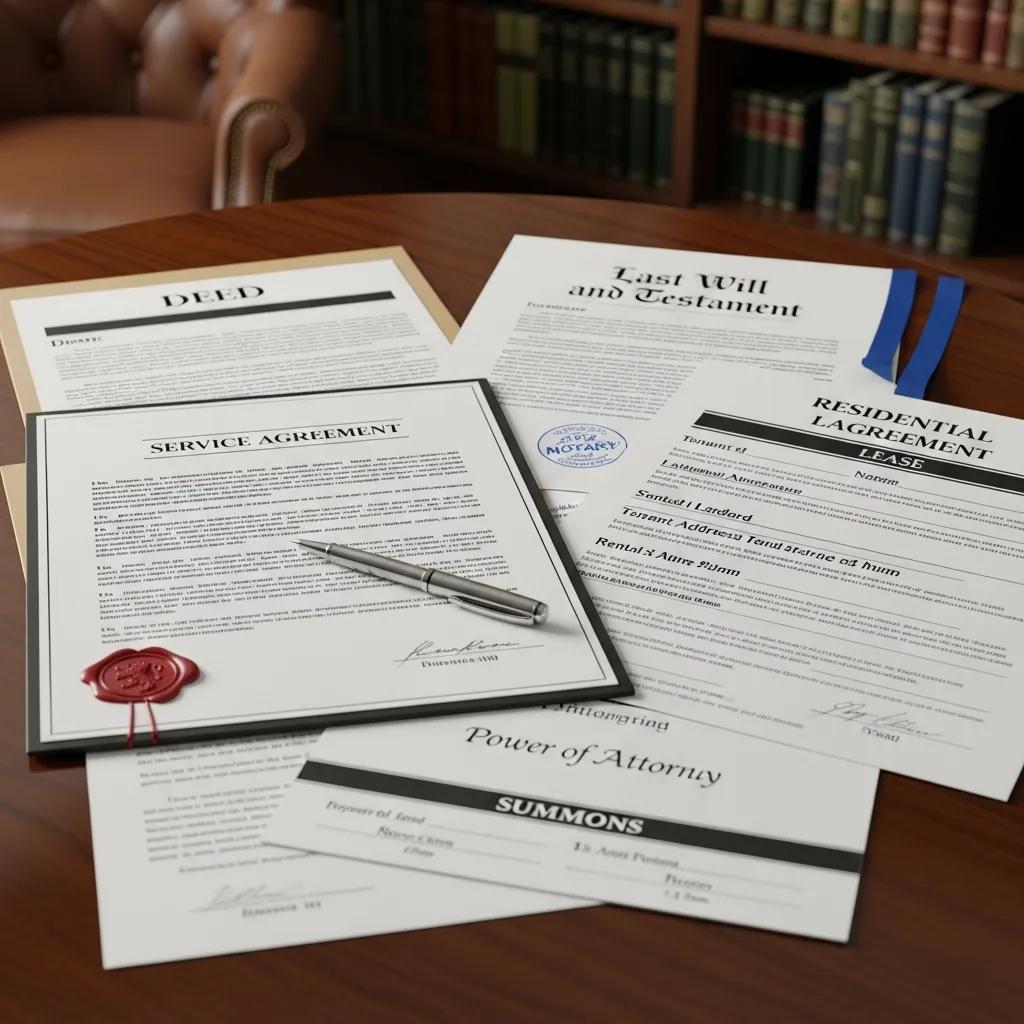
Legal documents come in predictable classes—contracts and agreements, wills and estate instruments, deeds and real estate conveyances, leases, and judicial opinions—and each serves a distinct legal purpose. Contracts allocate mutual obligations between parties, wills set posthumous distribution of assets, deeds transfer property interests, and leases create landlord-tenant rights for a defined term; judicial opinions explain how courts interpret law and bind future cases. The list below gives concise one-line definitions designed to help you identify documents at a glance and prioritize review.
- Contract: A negotiated agreement that creates mutual obligations enforceable by law.
- Last will and testament: A document directing distribution of assets and appointment of an executor after death.
- Deed (e.g., deed of trust): A conveyance transferring ownership or security interest in real property.
- Residential lease: A contract granting possession and use of property for a term in exchange for rent.
- Memorandum of understanding (MOU): A nonbinding or partly binding record of shared intentions between parties.
- Judicial opinion: A court’s written decision explaining the legal reasoning and holding in a case.
The concise list above helps prioritize which documents require immediate scrutiny; the next subsection outlines the distinct features and clauses typical to contracts, wills, deeds, and leases.
What Are the Main Features of Contracts, Wills, Deeds, and Leases?
Contracts commonly include offer, acceptance, consideration, definitions, warranties, indemnities, termination, and governing law clauses that define obligations, remedies, and risk allocation. Wills identify the testator, beneficiaries, executor, dispositions of property, and usually include witness statements and a testamentary signature block to satisfy formalities. Deeds transfer property by naming grantor/grantee, a legal description of the property, covenants of title, and a notarized signature; they often require recording to affect third parties. Leases set rent, term, permitted use, maintenance responsibilities, default remedies, and sometimes renewal or purchase options; ambiguous lease terms commonly create disputes over repair obligations or possession. Inspecting these features helps you spot clauses that commonly cause disputes and informs whether to seek clarification or negotiate changes.
To compare typical document purposes and the key clauses to watch, the table below provides a compact reference for quick review.
Different documents serve specific purposes and contain characteristic clauses that demand attention during review.
This comparison helps you quickly identify which clauses to prioritize when you open each document and prepares you to read clause language with a risk-focused lens.
What Are the Key Components and Clauses in Legal Documents?
Most legal documents share a set of core components—parties, recitals, definitions, operative clauses, signatures, and effective dates—that structure legal obligations and define how the document operates. Recognizing these components lets you map responsibilities, timelines, and triggers for action, and also reveals where drafting errors or ambiguities can create unintended liabilities. The entity-attribute-value table below compares how components typically appear across contracts, wills, deeds, and leases so you can see practical differences at a glance.
The table that follows compares essential components across common documents to help you identify what’s most important in each context.
This comparison highlights how the same component can change impact depending on the document type and stresses the importance of accurate names and clear operative language.
How Do Parties, Terms, Signatures, and Effective Dates Shape Legal Agreements?
Accurate party identification ensures the agreement binds the correct legal entity and avoids enforcement gaps; using a full legal name and entity type (e.g., LLC) prevents ambiguity. Terms specify obligations, performance standards, and timelines; unclear or conflicting terms can produce disputes over scope or payment triggers. Signatures, witness statements, and notarization are formalities that evidence intent and often are prerequisites for enforceability, especially for wills and deeds; missing or defective execution can render a document void. Effective dates determine when contractual duties start and when statutes of limitations or notice periods begin; misdating may shift liability windows or extinguish rights. These components jointly create the operational mechanics of a legal instrument and errors in any can change outcomes materially.
Recognizing how these elements interact sets up the next discussion about clauses—consideration and mutual assent—that form the backbone of contractual enforceability.
What Roles Do Clauses, Consideration, and Mutual Assent Play in Contracts?
Clauses like warranties, indemnities, confidentiality, limitation of liability, and termination allocate risk and outline remedies; each clause performs a discrete function in shaping incentives and exposures. Consideration—an exchange of value such as money, services, or promises—traditionally validates a contract by showing that parties bargained for something; absent consideration, a promise may be unenforceable unless supported by other doctrines such as promissory estoppel. Mutual assent or “meeting of the minds” requires that parties understand and agree to the same material terms; ambiguous drafting or undisclosed conditions can undermine mutual assent and lead to rescission or reformation. Translating clause language into plain English and testing whether consideration is present helps you determine whether the document creates enforceable obligations or whether negotiation is necessary.
Understanding these substantive building blocks prepares you to decode legal jargon and simplify complex language, which is the next major topic.
How Can You Decode Legal Jargon and Complex Language?

Legal language tends to be dense because it prioritizes precision, precedent, and risk allocation, often using terms like “heretofore,” “notwithstanding,” or defined terms that carry narrow legal meanings. Simplifying legalese involves identifying defined terms, breaking long sentences into clauses, substituting plain-English equivalents for archaic terms, and checking each defined term’s scope; this reduces misinterpretation while preserving legal nuance. The EAV glossary table below provides plain-English definitions for priority terms you will encounter and shows short example usages so you can apply translations during review.
This glossary clarifies common legal terms by pairing them with short definitions and examples to aid quick interpretation.
This compact glossary helps you translate recurring terms into actionable understanding and prepares you to apply simplification techniques in practice.
Why Is Legal Language Often Difficult and How Can You Simplify It?
Legal language evolved to minimize ambiguity across jurisdictions, relying on precedent and narrowly defined phrases, which makes documents precise but hard to read for nonlawyers. To simplify, start by locating a definitions section and then substitute each defined term with its plain-English equivalent within a working draft; next, break long sentences into subject-verb-object units and remove redundant modifiers while flagging any phrasing that could change legal meaning. Use reputable legal dictionaries for contested terms and preserve original phrasing in a redline copy when proposing edits so you maintain a record of legal intent. Simplification reduces reading time and misunderstanding but always be cautious: trimming language can alter legal effects, so retain the original for comparison and consult counsel for high-stakes changes.
Applying these techniques requires familiarity with common terms; the next subsection lists priority terms you should master and illustrates how they typically appear.
Which Common Legal Terms Should You Understand to Interpret Documents?
A working vocabulary accelerates comprehension: prioritize “shall/may,” “indemnity,” “warranty,” “assignment,” “breach,” “force majeure,” “governing law,” and “severability.” Each term shifts rights or remedies—“indemnity” transfers loss exposure, “force majeure” allocates unforeseen-event risk, and “governing law” decides which legal rules govern interpretation—so recognizing them quickly tells you where substantive risk sits. Practice by creating a two-column quick reference: term and plain-English meaning, and annotate one document with these translations to build fluency. Over time, a glossary reduces the burden of repeated lookups and lets you focus on material facts rather than parsing vocabulary.
Mastering these terms leads naturally into practical review strategies you can apply to any legal document, which is the next major section.
What Practical Strategies Help You Read and Interpret Legal Documents Effectively?
A practical workflow moves from a high-level skim to clause-level analysis and ends with a concise summary of material facts; this structured approach reduces oversight and makes negotiation or counsel review more efficient. Begin with a quick skim to identify parties, purpose, effective date, and any monetary obligations; then read definitions, highlight risk clauses (indemnity, liability, termination), and translate defined terms into plain language. The numbered checklist below provides a reproducible step-by-step process you can use each time you review a document and is optimized for quick application.
Use this step-by-step checklist to guide your document review from overview to final summary.
- Skim the document to identify parties, effective date, and primary purpose.
- Read the definitions section and substitute defined terms in a working draft.
- Highlight material clauses: payment, indemnity, termination, liability, and remedies.
- Extract obligations and deadlines into a timeline or obligations table.
- Note ambiguities or high-risk provisions and flag them for negotiation or counsel.
- Write a one-page executive summary covering who, what, when, obligations, and risks.
Following this checklist ensures consistent, repeatable reviews and makes it easier to spot material facts for decision-making. The next paragraphs explain tools that make the checklist more effective and show how to summarize sections concisely.
How Can Skimming, Highlighting, and Using Legal Dictionaries Improve Comprehension?
Skimming for structure first—titles, recitals, defined terms, signature blocks—lets you form a mental map of a document so you know where to focus deeper reading. Highlighting clauses by color code (e.g., red for liability, yellow for deadlines) creates a visual risk profile that speeds later review and negotiation preparation. Using a legal dictionary or glossary to confirm the meaning of contested terms ensures your plain-English substitutions are accurate and reduces the chance of misinterpretation. A brief worked example: skim to identify a renewal clause, confirm whether “automatic renewal” is triggered by notice or silence, and then highlight and translate the clause into a one-line obligation for monitoring—this turns dense wording into a practical action item.
A clear summarization method then captures material facts for decision-makers, which is described in the following subsection.
What Steps Should You Take to Identify Material Facts and Summarize Sections?
Use a reproducible template—Who? What? When? Obligations? Risks?—to extract material facts from each section and convert them into an executive summary that decision-makers can read quickly. For each clause, note the affected parties, the exact performance required, deadlines, monetary amounts, and triggers for termination or penalty; prioritization should focus on cost, liability, and the ability to cure breaches. A simple rubric helps: high priority for clauses with material financial exposure or ongoing obligations, medium for operational duties, and low for administrative provisions. Convert these findings into a one-page summary and a short timeline so negotiations or counsel review can proceed with clarity and focus.
Capturing material facts effectively also clarifies when you must escalate to legal counsel, which is the final major section.
When Should You Seek Professional Legal Advice for Document Review?
You should consult a lawyer whenever the document involves large sums, complex liability allocations, cross-jurisdictional issues, or ambiguous key obligations that could materially affect rights or duties. Counsel is especially important for estate-planning instruments, property transfers, long-term leases, and transactions involving indemnities or limitations of liability because legal advice can reframe risk, propose redlines, and draft protective language. The checklist below lists common red flags that indicate the need for professional review and can be applied as a quick decision aid before you sign.
- High financial exposure or significant ongoing obligations.
- Ambiguity in key obligations, remedies, or termination rights.
- Cross-border or multi-jurisdiction clauses that affect enforcement.
- Complex indemnity, insurance, or limitation-of-liability provisions.
If you see one or more of these red flags, legal counsel can provide a targeted review, draft redlines, and prepare a memo summarizing negotiation priorities. The next subsections expand on specific warning signs and what counsel typically delivers.
What Are the Signs That Indicate the Need for a Lawyer’s Help?
Explicit red flags include ambiguous payment triggers, unilateral termination rights without cure periods, broad indemnities that expose you to third-party claims, and clauses that waive fundamental rights such as class actions or jury trials. Cross-jurisdictional governing law or exclusive forum selections complicate enforcement and typically require counsel versed in the selected jurisdiction. If a document contains technical regulatory language, industry-specific compliance obligations, or unusual representations and warranties, you should seek legal advice before signing. Recognizing these signs early ensures you do not accept hidden liabilities and prepares you to present focused questions to counsel.
How Can Legal Counsel Protect Your Rights and Prevent Misinterpretation?
Legal counsel protects your rights by assessing risk, drafting or redlining language to limit liability, clarifying ambiguous terms, and advising on negotiation priorities and fallback positions; typical deliverables include a redlined document, an issues memo with recommended language, and an executive summary of material risks. Counsel can also draft protective clauses—such as defined cure periods, caps on liability, and explicit survival clauses—that reduce future exposure and increase predictability. When counsel provides a memo and redline, use those documents to guide negotiations and to document record of requested changes; this makes subsequent enforcement or disputes easier to manage. Preparing your documents and questions in advance accelerates counsel’s review and keeps costs proportionate to the complexity of the task.
This completes the structured guide to reading and interpreting common legal documents and leaves you with a reproducible workflow and reference materials to apply immediately.